
For a software company, these obligations land in the product: in consent screens, the data model, access controls, retention jobs, support tools and the incident process. Teams that treat PIPEDA as a legal document usually find the gaps during a customer's security review. Federal reform is also on the way, with Bill C-36 tabled in June 2026.
PIPEDA compliance for a software product comes down to ten principles turned into engineering work: purpose and consent records, minimal data collection, retention limits, role-based safeguards, user access and correction, breach detection and reporting, and contracts that keep protection in place when data is processed by vendors or outside Canada.
This article maps PIPEDA's ten principles to product and engineering tasks, explains breach rules and cross-border processing, compares PIPEDA with GDPR and HIPAA and shows a real healthcare platform. It is not legal advice.
Key takeaways
- PIPEDA rests on ten fair information principles, published by the Office of the Privacy Commissioner of Canada (OPC).
- Each principle maps to concrete product work, such as consent records, retention jobs, access controls and self-service data access.
- Breaches that create a real risk of significant harm must be reported to the OPC and to affected individuals, and every breach must be recorded and the record kept for 24 months.
- Using a vendor or an outsourced team, including one outside Canada, is allowed, but the organization stays accountable and must protect the data through contracts and tell users that data may be processed abroad.
- Bill C-36, tabled on 15 June 2026, would replace PIPEDA's privacy rules with a new act and penalties of up to $25 million or 5% of global revenue. PIPEDA applies until a new law takes effect.
- Some provinces have their own privacy or health information laws, so check which law applies to each data set.
PIPEDA's ten principles as engineering work
| Principle | What it means | Product and engineering tasks |
|---|---|---|
| Accountability | Someone is responsible for compliance | Named privacy owner, data inventory, privacy review in the release process |
| Identifying purposes | State why data is collected | Purpose recorded for each data field, purposes shown at collection |
| Consent | Meaningful consent for collection, use and disclosure | Clear consent screens, consent records with time and version, easy withdrawal |
| Limiting collection | Collect only what is needed | Review of every new field, optional fields marked, no collection "just in case" |
| Limiting use, disclosure and retention | Use data only for stated purposes and keep it only as long as needed | Retention periods per data type, automated deletion or anonymization jobs |
| Accuracy | Keep data accurate enough for its purpose | Validation, user editing, sync rules between systems |
| Safeguards | Protect data according to its sensitivity | Encryption, role-based access, audit logs, penetration testing, secure development |
| Openness | Make privacy practices available | Plain-language privacy notice, in-product explanations |
| Individual access | People can see and correct their data | Self-service export and correction, support tooling for access requests |
| Challenging compliance | People can complain and get an answer | Contact channel, request tracking, documented responses |
The OPC's summary of the principles is the reference for each one.
Consent that holds up
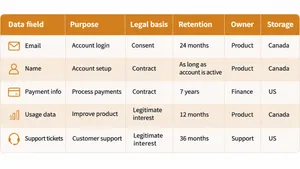
- Explain purposes in plain language at the moment of collection, not only in a long policy.
- Separate optional uses, such as marketing or research, from what the service needs to work.
- Record consent with the user, the time, the purpose and the version of the wording shown.
- Make withdrawal easy, and make sure systems actually stop the related processing.
- Treat sensitive data with more care. Health, financial and similar information usually needs express consent and stronger safeguards.
Breach reporting
Since 1 November 2018, PIPEDA has required organizations to act on breaches of security safeguards. According to the OPC's guidance, organizations must:
- Assess the risk. Decide whether the breach creates a real risk of significant harm, considering how sensitive the information is and how likely it is to be misused.
- Report to the OPC when that risk exists, with details of the breach, the information affected, the number of people and the steps taken.
- Notify affected individuals as soon as feasible, explaining what happened and what they can do.
- Notify other organizations that can help reduce the harm, where relevant.
- Keep records of every breach, whether reportable or not, for 24 months.
For engineering teams, this means logging and alerting good enough to detect incidents, audit trails that show which records were accessed, and an incident process that produces the facts the report needs quickly. Our guide to audit logs covers what to record.
Vendors, cloud and outsourced development
Canadian companies often process data in foreign clouds or work with development teams outside Canada. The OPC's guidance on processing across borders treats a transfer to a service provider as a use of the information, so no extra consent is needed when the data is used for the purpose it was collected for. Two conditions apply:
- Accountability stays with you. The organization must ensure a comparable level of protection, mainly through contracts, and check the provider's policies, training and security, with audit rights it can use.
- Transparency to users. People must be told that their information may be processed in another country and may be accessible to that country's courts and authorities.
In practice, that means a data processing agreement with every vendor and development partner, access limited to the data each person needs, development and test environments that use masked or synthetic data, and a privacy notice that names the countries involved. Our guide to software development outsourcing agreements covers the clauses, and our article on SOC 2 for startups explains how external developers fit into security controls.
Building a product for Canadian users or handling health data? We build platforms with privacy and security controls that meet PIPEDA, HIPAA and SOC 2 expectations.
Explore healthcare softwarePIPEDA, GDPR and HIPAA compared
| PIPEDA | GDPR | HIPAA | |
|---|---|---|---|
| Applies to | Private-sector organizations handling personal information in commercial activities in Canada | Organizations processing personal data of people in the EU | US covered entities and their business associates handling health information |
| Legal basis | Consent, with exceptions | Six legal bases, including consent and legitimate interests | Permitted uses for treatment, payment and operations, authorization for others |
| Breach notice | To the OPC and individuals when there is a real risk of significant harm | To the authority within 72 hours when there is a risk, to individuals when the risk is high | To individuals and HHS, with timing based on the number affected |
| Cross-border transfers | Allowed with comparable protection and transparency | Restricted to adequate countries or with safeguards such as standard contractual clauses | No specific transfer rule, contracts with business associates required |
| Penalties | Fines of up to $100,000 for certain offences today, larger penalties proposed under Bill C-36 | Up to €20 million or 4% of global turnover | Civil and criminal penalties by tier |
Products used in several regions usually design for the strictest common requirements and add region-specific features, such as data residency or specific consent wording, where needed.
What is changing: Bill C-36
Bill C-36, the proposed Protecting Privacy and Consumer Data Act, was tabled on 15 June 2026. It is the third attempt to replace PIPEDA's privacy rules, after earlier bills died when Parliament ended. As summarized by Gowling WLG, it would require documented privacy management programs, privacy impact assessments before transferring personal information outside Canada, explanations and human review for automated decisions with significant effects, and new rules for de-identified and anonymized data. Penalties could reach the greater of $25 million or 5% of gross global revenue for the most serious offences. The bill still has to pass Parliament, so PIPEDA remains the law for now, but teams building products today should design for these requirements.
A real platform: HIPAA and PIPEDA-aligned workflows
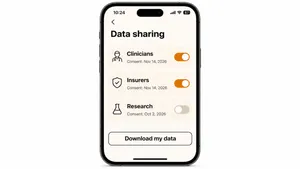
A Canadian healthcare startup, working with .wrk under NDA, lets patients track chronic pain and share their data with clinicians and insurers. Its insurance partners required SOC 2 Type 2 and strict data governance, and its legacy Drupal 6 platform could not meet the security requirements.
Over a multi-year engagement, a .wrk team:
- Rebuilt core services as Symfony microservices and restricted the legacy system to admin-only functions that auditors could isolate.
- Introduced HIPAA and PIPEDA-aligned workflows, with code review gates, role-based approvals and third-party penetration testing.
- Built a patient alert engine with audit-friendly storage of every result.
- Supported SOC 2 Type 2 certification through dedicated remediation sprints.
API calls became about five times faster, monthly outages stopped after the infrastructure upgrade, and the company signed insurer contracts with a platform that passed scrutiny. Read the healthcare platform case study.
A PIPEDA checklist for product teams
- A named privacy owner and a current inventory of personal data, its purposes and where it is stored.
- Consent screens with recorded consent and easy withdrawal.
- A review of new data fields before they ship.
- Retention periods and automated deletion or anonymization.
- Encryption, role-based access and audit logs for personal data.
- Self-service data access and correction, plus a process for requests.
- Breach detection, an incident runbook and a breach record kept for 24 months.
- Contracts with every vendor and development partner, and transparency about processing outside Canada.
- A check of provincial privacy and health information laws that may also apply.
Frequently asked questions
What is PIPEDA?
PIPEDA is Canada's federal privacy law for the private sector. It sets rules for how organizations collect, use and disclose personal information in commercial activities, based on ten fair information principles, and requires reporting of serious breaches.
Does PIPEDA apply to software companies outside Canada?
It can. PIPEDA can apply to foreign organizations that collect, use or disclose personal information of people in Canada in the course of commercial activities, depending on their connection to Canada. Get legal advice for your situation.
Can Canadian companies use developers or cloud services outside Canada?
Yes. Transferring personal information to a service provider is allowed, but the company remains accountable, must ensure comparable protection through contracts and must tell users that their data may be processed in another country.
What are the PIPEDA breach notification requirements?
When a breach creates a real risk of significant harm, organizations must report it to the Privacy Commissioner, notify affected individuals as soon as feasible and inform organizations that can help reduce the harm. All breaches must be recorded, and records kept for 24 months.
What is the difference between PIPEDA and GDPR?
Both protect personal information, but PIPEDA relies mainly on consent, while GDPR allows six legal bases. GDPR sets a 72-hour deadline for notifying the authority, restricts transfers outside the EU more strictly and has higher fines. Bill C-36 would bring Canadian rules closer to GDPR in several areas.
To sum up
PIPEDA compliance happens in the product: consent records, minimal data collection, retention jobs, safeguards, self-service access, breach detection and vendor contracts. Map each of the ten principles to engineering work, keep accountability when data is processed by vendors or abroad and prepare now for the stricter rules proposed in Bill C-36.
.wrk builds and modernizes software for companies in Canada, the US and Europe, including healthcare platforms with HIPAA and PIPEDA-aligned workflows, SOC 2 controls and audit-ready data handling.
Need your product to meet Canadian privacy requirements? Tell us about your data and users, and we will propose the engineering changes and a plan.
Explore healthcare software