
If you are asking "how much does AI cost for a business," the short answer is that the model itself is rarely the expensive part. Budgets grow because of data preparation, integrations, accuracy requirements and the team you choose to build with.
This guide breaks down typical AI development cost ranges by project type, current AI developer rates per hour, the running costs that appear after launch and the practical ways to keep the budget under control.
AI development cost at a glance
The table below shows typical budgets for common AI projects. The ranges assume a blended team rate of roughly $50–$120 per hour, which is typical for nearshore and Central European teams. A team based fully in the US will usually land at the top of each range or above it.
| Project type | What it usually includes | Timeline | Team size | Typical cost |
|---|---|---|---|---|
| AI proof of concept | One use case tested on real data, basic UI, a short evaluation report | 4–6 weeks | 2–3 people | $20,000–$60,000 |
| AI feature in an existing product | Summaries, drafting, classification or search added through an LLM API | 6–10 weeks | 2–4 people | $30,000–$90,000 |
| Knowledge-base assistant (RAG) | Answers grounded in your documents, with citations and access controls | 8–14 weeks | 3–5 people | $50,000–$150,000 |
| Document processing pipeline | Extraction, classification and validation of PDFs, scans or forms, with a review queue | 8–16 weeks | 3–5 people | $60,000–$180,000 |
| AI agent with tool integrations | An agent that reads data and takes actions in CRM, ticketing or internal tools | 10–20 weeks | 4–6 people | $80,000–$250,000 |
| Custom or fine-tuned model | Training data preparation, model training, evaluation and MLOps | 12–24 weeks | 4–8 people | $120,000–$400,000 |
| Enterprise AI platform | Several use cases on shared infrastructure, governance and monitoring | 6–12 months | 6–12 people | $300,000 and more |
Want a realistic budget for your AI use case? We scope it in a short discovery and give you a cost range before any build starts.
Get an AI cost estimateAI developer cost per hour in 2026
Hourly rates are the single biggest multiplier in any AI budget. The same 1,500-hour project can cost $75,000 or $300,000 depending on where the team is based and how senior it is.
Rates by region
| Region | Mid-level AI/ML engineer | Senior AI/ML engineer |
|---|---|---|
| United States | $100–$150 per hour | $130–$220 per hour |
| Western Europe | $80–$120 per hour | $100–$160 per hour |
| Central and Eastern Europe | $45–$75 per hour | $60–$110 per hour |
| Latin America | $45–$75 per hour | $60–$110 per hour |
| South and Southeast Asia | $25–$45 per hour | $40–$70 per hour |
For in-house hiring, the US Bureau of Labor Statistics puts the 2025 median pay for computer and information research scientists at $140,300 per year. That figure is base salary only. Benefits, equipment, recruiting fees and management time push the real cost of an in-house AI engineer well above it.
Rates by role
Most AI projects need more than "an AI developer." A typical team combines several roles, and each one is priced differently.
| Role | What they do on an AI project | When you need them |
|---|---|---|
| AI/LLM engineer | Designs prompts, retrieval and agent logic, and connects models to your systems | Almost every generative AI project |
| ML engineer | Trains, fine-tunes and evaluates models | Custom models, prediction and classification at scale |
| Data engineer | Builds pipelines that clean, move and prepare data | Whenever data is scattered or messy |
| Backend engineer | Builds APIs, integrations and business logic around the AI | Any project that goes into production |
| MLOps or DevOps engineer | Handles deployment, monitoring, scaling and cost control | Production systems and on-premise setups |
| QA engineer | Tests outputs, edge cases and regressions | Any system where errors carry a cost |
| AI architect or tech lead | Chooses the approach and owns technical risk | Complex, regulated or multi-system projects |
What drives AI development cost
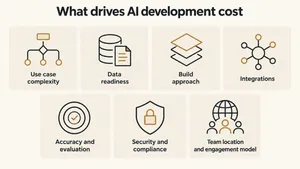
Seven factors explain most of the difference between a $40,000 project and a $400,000 one.
1. Use case complexity
A feature that summarizes a support ticket is much cheaper than an agent that reads the ticket, checks the CRM and issues a refund. Every extra decision the system makes on its own adds design, testing and safety work.
2. Data readiness
Clean, accessible data keeps costs down. If your documents sit in five systems, include scans or need labeling, data preparation can become the largest line item in the project.
- Structured data in one system with an API is the cheapest starting point.
- Unstructured documents such as PDFs, emails and scans add extraction and validation work.
- Data that needs manual labeling for training adds weeks of effort and specialist time.
3. Build approach
The technical approach you choose sets the baseline for both the build cost and the running cost.
| Approach | How it works | Build cost | Best for |
|---|---|---|---|
| LLM API integration | Your app sends requests to a hosted model such as GPT or Claude | Low | Drafting, summaries, classification, chat |
| Retrieval-augmented generation (RAG) | The model answers using your own documents as context | Medium | Knowledge assistants, support, internal search |
| Fine-tuning | An existing model is further trained on your examples | Medium to high | Consistent format, tone or domain language |
| Custom model | A model is trained from your data for a specific task | High | Prediction, scoring, vision, niche domains |
Most business use cases in 2026 start with API integration or RAG. Fine-tuning and custom models make sense once you have proven the use case and have enough quality data to justify them.
4. Integrations
AI that lives in a separate tool is cheaper to build and harder to adopt. Connecting it to your CRM, ERP, CMS, ticketing system or phone system adds engineering time, and it is usually the part that makes the project pay off.
5. Accuracy and evaluation
The higher the cost of a wrong answer, the more you spend on testing. A marketing draft tool can tolerate some errors. A tool that prepares legal or medical summaries needs test sets, human review steps and regression checks before every release.
6. Security, compliance and hosting
Strict data rules raise the budget. On-premise deployment, data residency, access controls and audit logs all add work. Companies selling into the EU also need to plan for the EU AI Act, whose transparency rules apply from August 2026 and whose high-risk obligations follow in December 2027.
7. Team location and engagement model
Where the team sits and how you engage it changes the total more than any technology choice. A nearshore or Central European team working as an extension of your own engineers often delivers the same scope at half the cost of a fully US-based team.
Running costs after launch
The build is only part of the cost. Once AI is live, you pay every month for usage, infrastructure and upkeep.
| Cost item | What it covers | How to keep it in check |
|---|---|---|
| Model and API usage | Tokens sent to and returned by hosted models | Route simple tasks to smaller models and cache repeated requests |
| Infrastructure | Hosting, vector databases, GPUs for self-hosted models | Right-size environments and scale on demand |
| Monitoring and evaluation | Quality checks, logs, alerts, cost dashboards | Automate evaluation on a fixed test set |
| Maintenance | Prompt updates, model version changes, bug fixes | Document prompts and keep regression tests |
| Human review | Staff time spent checking low-confidence outputs | Send only uncertain cases to people |
Model choice has a big effect on usage costs. On the OpenAI API pricing page, the input price of the flagship model is 25 times higher than that of the smallest model in the same family. Sending routine tasks to a smaller model is one of the easiest savings available.
Real numbers help here. In our AI legal document processing project for a US law firm, model usage came to about $3–4 per case bundle of roughly 250 pages. For most document-heavy workflows, the running cost of the model is small compared with the staff time it replaces.
A reasonable planning assumption is to set aside 15–25% of the initial build cost per year for maintenance and improvements, plus usage fees.
How much does AI cost for a business? Three example budgets
The right budget depends on company size and ambition. These examples show what a realistic first step looks like at three levels.
| Business | Typical first project | Build budget | Monthly running cost |
|---|---|---|---|
| Small business | AI-assisted drafting, email triage or a simple support assistant built on an API | $15,000–$40,000 | $100–$1,000 |
| Mid-market company | A RAG knowledge assistant or document processing pipeline connected to one core system | $50,000–$150,000 | $1,000–$5,000 |
| Enterprise | Several use cases on shared infrastructure, with governance, SSO and monitoring | $250,000–$1,000,000 | $10,000 and more |
How to reduce AI development cost without cutting corners
Cost overruns are one of the main reasons AI projects stall. Gartner predicts that over 40% of agentic AI projects will be canceled by the end of 2027 because of escalating costs, unclear business value or weak risk controls. In the McKinsey State of AI survey, one in five respondents said costs are limiting their use of AI.
These practices keep budgets predictable:
- Start with a proof of concept on real data. A four to six week test shows whether the use case works before you commit to a full build.
- Use hosted models before you train your own. API integration and RAG solve most business problems at a fraction of the cost of a custom model.
- Define success metrics up front. Agree on accuracy, time saved or cost per task before development starts, so you know when to stop or scale.
- Match the model to the task. Use large models only where the task needs them and route the rest to cheaper ones.
- Keep humans in the loop for edge cases. Sending only low-confidence results to people is cheaper than chasing perfect accuracy.
- Build on the stack you already have. Adding AI to existing systems avoids the cost of a parallel platform.
- Choose a team that has shipped similar systems. Experience with your type of use case shortens discovery and cuts rework.
In-house team vs outsourced AI development
Hiring your own AI team makes sense when AI is core to your product for years ahead. For a first project or a defined use case, an external team is usually faster and cheaper.
| Factor | In-house AI team | Outsourced AI development |
|---|---|---|
| Time to start | Three to six months to hire | Two to four weeks to onboard |
| Cost structure | Salaries, benefits, recruiting and tools | Hourly or monthly rate for the team you need |
| Skills coverage | Limited to the people you hire | Access to several roles as the project needs them |
| Flexibility | Hard to scale down after the project | Team size follows the roadmap |
| Knowledge retention | Stays inside the company | Needs documentation and handover built into the contract |
Many companies combine both. They keep product ownership and a small internal team, then add external AI engineers through staff augmentation or a dedicated team for delivery.
Planning an AI project and need a clear budget? Our AI engineers help you pick the right approach and cost it before you commit.
Explore AI servicesFrequently asked questions
How much does it cost to build an AI app?
A simple AI app built on a hosted model usually costs $30,000–$90,000. An app with a knowledge base, integrations and user management typically costs $80,000–$200,000. Apps that need custom models or strict compliance can go above $300,000.
What is the average AI developer cost per hour?
In 2026, senior AI engineers typically charge $130–$220 per hour in the US, $100–$160 in Western Europe and $60–$110 in Central and Eastern Europe. Mid-level engineers cost less, and specialists in areas such as MLOps or computer vision often cost more.
How long does AI development take?
A proof of concept takes four to six weeks. Most production AI features take two to four months. Enterprise platforms with several use cases usually take six to twelve months.
Is it cheaper to use an API than to build a custom AI model?
In most cases, yes. API integration removes the cost of training and hosting a model, so you pay only for development and usage. A custom model becomes worth it when you have large volumes of quality data and a task that hosted models handle poorly.
What ongoing costs should I budget for?
Plan for model usage fees, hosting, monitoring and regular maintenance. A common planning figure is 15–25% of the build cost per year, plus usage fees that grow with the number of requests.
To sum up
AI development cost in 2026 depends less on the model and more on scope, data, integrations and the team. A focused proof of concept can cost $20,000–$60,000, while production systems usually fall between $50,000 and $250,000.
The safest path is to start with one well-defined use case, test it on real data and scale only what proves its value. That keeps the budget tied to results instead of experiments.
At .wrk, we help US and European companies plan and build AI systems with a clear budget from the first call. Our engineers scope the use case, test it on your data and give you a cost range before any development starts.