
In most contact centers, a QA analyst still picks a handful of calls per agent each month and gives feedback weeks later. The sample is too small to be fair to agents or to catch problems early. Automatic scoring changes that, and it raises its own questions about accuracy, privacy and how agents are treated.
AI call center quality assurance works when the scorecard is written as specific, checkable items, every AI score comes with evidence from the transcript, a sample of calls is still scored by people to measure agreement, and results are used for coaching and process fixes.
This article compares manual and AI quality assurance, explains how to design a scorecard a model can apply, how the scoring pipeline works, how to calibrate it, the privacy and legal points to check and how a telecom operator moved to scoring 100% of recorded calls. It does not cover workforce scheduling or voice bots in detail.
Key takeaways
- Manual QA usually covers a small sample of calls. AI scoring can cover every recorded call.
- Write scorecard items as observable behaviors, such as "agent confirmed the customer's identity", not impressions such as "agent was professional".
- Every AI score should cite the part of the transcript that supports it, so supervisors and agents can check it.
- Keep people in the loop: score a sample of calls manually each month and track how often people and AI agree.
- Redact payment and personal data from transcripts, tell callers and agents how recordings are used and check local law, including the EU AI Act's ban on inferring employees' emotions at work.
- A telecom operator that had reviewed fewer than 2% of calls by hand now transcribes and scores 100% of recorded calls on its own infrastructure.
Manual QA vs AI QA
| Manual quality assurance | AI quality assurance | |
|---|---|---|
| Coverage | A few calls per agent per month | Every recorded call |
| Time to feedback | Days or weeks | Minutes after the call |
| Consistency | Varies between analysts | The same checklist applied the same way, with its own error patterns |
| What analysts do | Mostly listening and scoring | Reviewing flagged calls, calibrating, coaching |
| Finding trends | Hard, the sample is small | Patterns across thousands of calls, by topic, product or agent |
| Main risks | Unfair samples, slow feedback | Scoring errors, privacy, over-reliance on numbers |
Designing a scorecard a model can apply
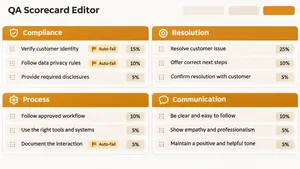
A scorecard that works for AI also works better for people. Each item should describe something that either happened in the conversation or did not.
| Section | Example items | Type |
|---|---|---|
| Compliance | Confirmed identity before discussing the account. Read the required disclosure. Did not promise a refund outside policy | Pass or fail, some items fail the whole call |
| Resolution | Identified the reason for the call. Resolved it or explained the next step and timeline | Pass, partial or fail |
| Process | Logged the correct reason code. Offered the correct product for the stated need | Pass or fail |
| Communication | Summarized the outcome before ending the call. Did not interrupt the customer repeatedly | Pass or fail, with evidence |
Avoid items that ask the model to judge personality or mood. They are hard to verify, hard to explain to agents and, in some jurisdictions, legally restricted when applied to employees.
How the scoring pipeline works
- Capture. The phone system stores each call recording with metadata, such as queue, agent and time.
- Transcribe. A speech recognition model converts the audio to text and separates the speakers, so the agent's and the customer's words are distinct.
- Redact. Card numbers, account numbers and other sensitive data are removed from the transcript before analysis or storage.
- Score. Rules handle simple checks, such as whether a disclosure phrase was said. A language model handles items that need understanding, such as whether the issue was resolved. Each score includes the quoted evidence and a confidence level.
- Route. Low-confidence scores and failed compliance items go to a human reviewer. Everything else goes to dashboards.
- Act. Supervisors receive alerts for calls that need attention, results flow to the CRM or ticketing system and coaching sessions use real examples.
Calibrating AI scores against people
Calibration keeps automatic scoring honest.
- Build a gold set. Have experienced analysts score 100–200 calls independently, discuss disagreements and agree on the correct result for each item.
- Measure agreement per item. Compare AI results with the gold set item by item. Some items will match people closely, others will need rewording or rules.
- Fix the weakest items first. Rewrite vague items, add examples to the scoring instructions or move simple checks to rules.
- Recalibrate monthly. Score a fresh sample by hand every month, since products, scripts and customer language change.
- Let agents dispute scores. A simple dispute process catches errors and builds trust in the system.
Reviewing only a sliver of your calls? We build call transcription and scoring pipelines, on your infrastructure or in the cloud, with calibration built in.
Explore AI servicesPrivacy, consent and fair use
- Tell callers. Most jurisdictions require callers to be informed that calls are recorded, and some US states require consent from everyone on the call.
- Tell agents. Explain what is scored, how scores are used and how to dispute them.
- Redact and limit. Remove payment data, which also matters for PCI DSS, and keep transcripts only as long as the retention policy allows.
- Watch emotion recognition. The EU AI Act has prohibited AI systems that infer the emotions of people in the workplace since 2 February 2025, except for medical or safety reasons. Scoring an agent's emotions in the EU therefore needs legal review, while checking what was said and done does not raise the same issue.
- Keep decisions human. Use scores for coaching and process improvement. Decisions about an individual's employment should rest with people who have reviewed the evidence.
- Know where data goes. Recordings often contain sensitive information. For regulated industries, running speech recognition on your own infrastructure keeps audio inside your perimeter.
The ISO 18295-1 standard for customer contact centers sets service requirements that many operators use as a reference when defining what good service looks like.
A real deployment: 100% of calls scored at a telecom operator
A regional telecom operator with over 12 million mobile subscribers, working with .wrk under NDA, handled peaks above 12,000 inbound calls a day across sales, billing and technical support. Recordings were stored on the operator's phone system with no systematic transcription, and QA teams reviewed fewer than 2% of calls by hand, with no structured scoring or alerting. Regulation required subscriber voice data to stay inside the operator's perimeter, so cloud speech services were not an option.
A team of a project manager, two AI engineers, two backend engineers and a DevOps engineer built the system on-premise.
- Transcription of every recorded call with NVIDIA's Parakeet speech recognition model, including speaker separation.
- An analysis pipeline that takes each transcript through language model and rule-based scoring against a checklist.
- Alerts and integration. Call summaries, scores and escalation flags go to the operator's existing CRM and ticketing system by webhook, and supervisors receive alerts for calls that need attention.
- A weekly tuning loop with contact center supervisors, reviewing dashboards and adjusting the scoring.
- High availability on a two-node cluster in the operator's data center, so analysis continues if a node fails.
Within 12 weeks of go-live on two pilot sites, the operator had every recorded call transcribed and scored, visibility across all recorded interactions and full compliance with its data rules, without external speech APIs or replacing its CRM. Read the on-premise voice AI case study.
What to measure
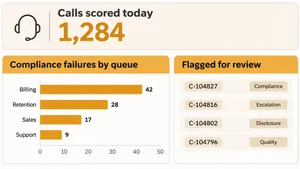
| Measure | Why it matters |
|---|---|
| Coverage | Share of recorded calls transcribed and scored |
| Agreement with human reviewers | Shows whether AI scores can be trusted, item by item |
| Time to feedback | How soon after a call the agent receives coaching |
| Compliance failure rate | Trend of missed disclosures, identity checks and policy breaches |
| First contact resolution | Whether coaching improves resolution |
| Disputed scores | Rising disputes point to scoring problems or unclear items |
The architecture choices behind the deployment above, including GPU sizing and the cost comparison with cloud speech services, are covered in our guide to on-premise AI. For other customer service automation, see our list of AI agent use cases.
Frequently asked questions
What is AI call center quality assurance?
AI call center quality assurance uses speech recognition and language models to transcribe recorded calls and score them against a quality checklist. It covers every call and flags calls that need a supervisor's attention.
How accurate is AI call scoring?
Accuracy varies by scorecard item. Clear, observable items, such as reading a disclosure, can match human reviewers closely, while vague items match less well. Measure agreement against a set of calls scored by experienced analysts, item by item, and improve the weakest items first.
Does AI replace QA analysts?
No. It changes their work. Analysts spend less time listening to random calls and more time reviewing flagged calls, calibrating the scoring, analyzing trends and coaching agents.
Is it legal to analyze call recordings with AI?
Generally yes, with conditions. Callers must usually be told calls are recorded, some places require consent from all parties, personal and payment data must be protected, and in the EU, AI systems that infer employees' emotions at work are prohibited except for medical or safety reasons. Check the law in each country where you operate.
What should a call center QA scorecard include?
Include compliance items, such as identity checks and required disclosures, resolution items, process items, such as correct logging, and communication items, such as summarizing the next steps. Write each as an observable behavior that can be checked against the transcript.
To sum up
AI makes it possible to score every call, provided the scorecard is specific, every score cites evidence, people calibrate the system every month and results are used to coach. Protect recordings, redact sensitive data and check the rules on monitoring employees before rollout.
.wrk builds speech analytics, call scoring and voice AI systems for contact centers in the US and Europe, including on-premise deployments for regulated industries.
Want every call scored and every compliance miss flagged? Tell us about your contact center and data rules, and we will propose a scoring pipeline and rollout plan.
Explore AI services